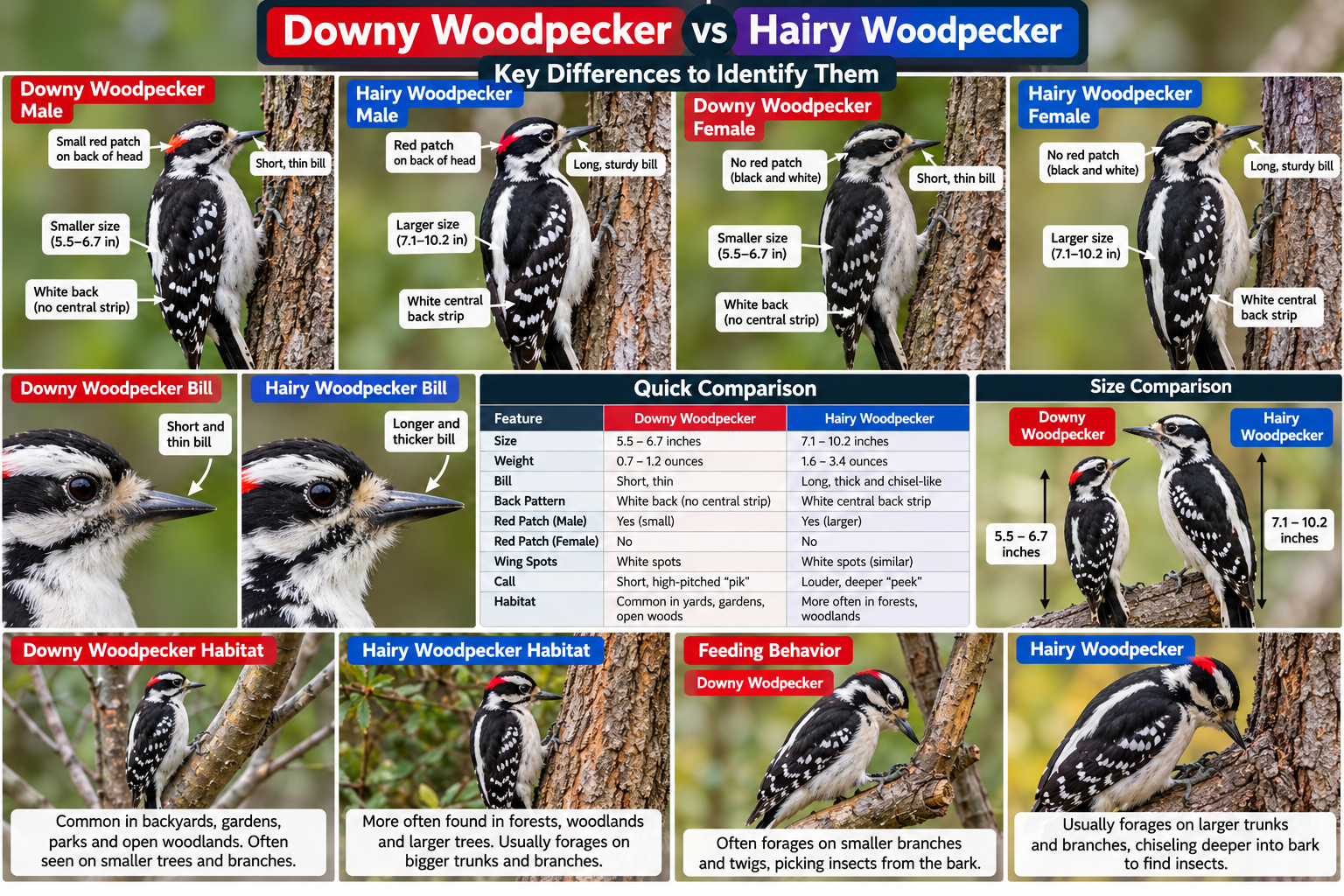
Downy Woodpecker vs Hairy Woodpecker: These two North American woodpeckers are among the easiest backyard birds to confuse. This practical guide explains the differences in bill length, body size, tail markings, calls and feeding behavior.
Quick answer: Downy Woodpecker vs Hairy Woodpecker
Downy Woodpeckers and Hairy Woodpeckers look remarkably alike: both have black-and-white wings, a white back stripe and a similar head pattern. The most useful clue is bill length relative to head size. A Downy Woodpecker usually has a short, stubby bill, while a Hairy Woodpecker has a noticeably longer, chisel-like bill. Size and voice can reinforce the identification.
Both species can visit wooded backyards and suet feeders, so habitat alone rarely settles the question.
Downy vs Hairy Woodpecker comparison chart
| Identification feature | Downy Woodpecker | Hairy Woodpecker |
|---|---|---|
| Typical length | About 5.5–6.7 inches (14–17 cm) | About 7.1–10.2 inches (18–26 cm) |
| Bill | Short; much shorter than head length | Long; often approaching head length |
| Overall build | Small and compact | Larger, sturdier appearance |
| Outer tail feathers | Often show small black spots | Usually appear unspotted white |
| Call | High, sharp pik; descending whinny | Stronger peek; more even-pitched rattle |
| Feeding sites | Small branches, stems and suet feeders | Larger branches and trunks; also suet feeders |
Measurements and field marks overlap or vary with sex, age and location. Use multiple clues instead of one.
1. Compare bill length first
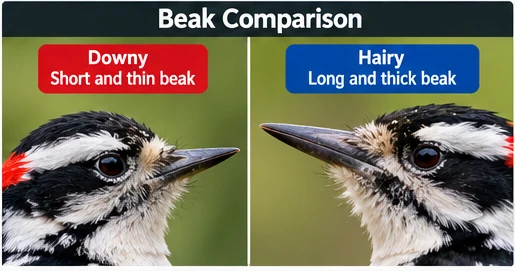
Imagine placing the bill against the length of the bird’s head. A Downy Woodpecker’s bill usually looks small and delicate, roughly a third of head length in many views. A Hairy Woodpecker’s bill looks more substantial and may approach the length of its head. Viewing angle can distort this relationship, so a clean side view is best.
2. Notice the overall size
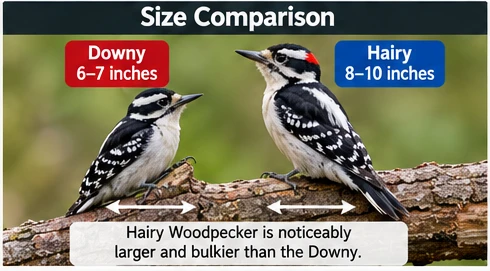
A Downy Woodpecker is a compact bird, often compared with a sparrow in overall size. A Hairy Woodpecker is considerably larger, although judging size is difficult when the bird is alone. A familiar feeder, branch or another bird in the same plane can provide useful scale. Avoid using camera zoom as a size reference.
3. Inspect the outer tail feathers
Many Downy Woodpeckers have small black spots or bars on their white outer tail feathers. Hairy Woodpeckers generally have cleaner white outer tail feathers. This clue is useful when the tail is visible, but feather wear, individual variation and some regional populations can complicate it. Do not rule out a species based on one blurry tail photograph.
4. Compare the calls
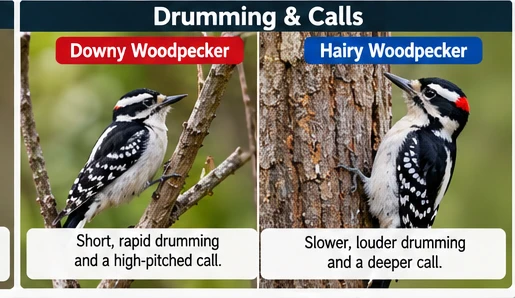
Downy Woodpeckers commonly make a short, sharp pik and a descending whinny. Hairy Woodpeckers often give a stronger, sharper peek and a more even-pitched rattling call. Listening to multiple recordings is helpful because individual calls can vary and nearby noise can obscure them. Compare audio examples at Cornell Lab’s All About Birds.
5. Watch where each bird forages
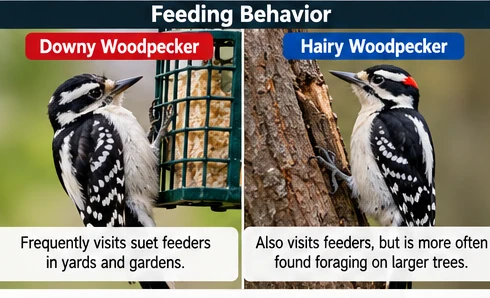
Downy Woodpeckers frequently work thin branches, weed stems and smaller trees. Hairy Woodpeckers often forage on thicker trunks and larger branches. However, both use a range of surfaces, and either can visit a suet feeder. Foraging location should support, not replace, structural field marks.
6. Look at the black-and-white pattern
Both species have a bold black-and-white pattern with a broad white stripe down the back and white spotting on the wings. Adult males generally show red on the back of the head, while females lack that red patch. Because their overall patterns are so similar, plumage is often less useful than bill length, size and voice.
7. Male vs female identification
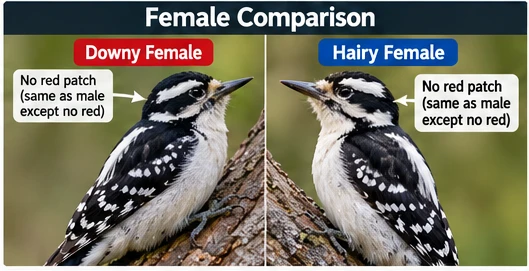
Sexing a Downy or Hairy Woodpecker is a different question from distinguishing the two species. In both species, adult males typically have a small red patch at the rear of the crown, and adult females generally do not. Juveniles may show red in different positions, so head color should not be treated as a perfect indicator of age or sex.
8. Consider habitat and geographic range
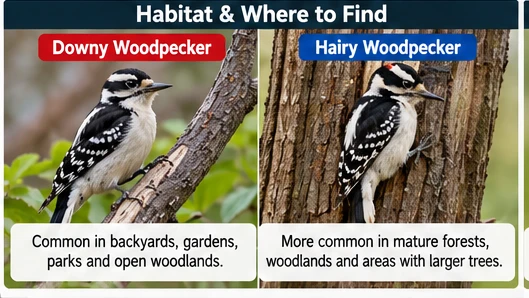
Both Downy and Hairy Woodpeckers occur across large parts of North America and can overlap in forests, parks and wooded neighborhoods. Downy Woodpeckers are often especially conspicuous in suburban yards and smaller wooded areas. Hairy Woodpeckers may favor more extensive woodland, but local conditions vary. Neither the state nor the season alone provides a reliable identification.
9. Identify them at a backyard feeder
At a suet feeder, first look at the bill profile, then compare the bird’s body against the feeder dimensions. If the outer tail feathers are visible, look for dark spots. Make a note of any calls. A photo showing the entire side of the bird is more useful than a close crop of the head alone.
For other birds you may encounter at feeders, see our Backyard Birds of the Midwest identification guide. You can also compare two frequently confused seed-eaters in our House Finch vs Purple Finch guide.
Common identification mistakes
The most frequent error is assuming that a bird must be a Hairy Woodpecker because it looks large in a zoomed-in photo. Another is relying exclusively on tail spotting, which may be hidden. Red on the head does not separate Downy from Hairy Woodpeckers: males of both species can show it. Combine the bill, body size, tail, voice and behavior for a more dependable identification.
Frequently asked questions
Which woodpecker is smaller, Downy or Hairy?
The Downy Woodpecker is generally much smaller, with a shorter bill and more compact body.
Do both species visit suet feeders?
Yes. Both can eat suet, although Downy Woodpeckers are often familiar visitors to backyard feeding stations.
Does a red patch mean it is a Hairy Woodpecker?
No. Adult males of both species can have red at the back of the head.
Can a Hairy Woodpecker have spots on its tail?
Tail markings vary, and visibility is often poor. Use the bill and size alongside tail markings rather than depending on one feature.
What is the best photo angle for identification?
A side view showing the bill, head, full body and outer tail feathers is usually most informative.