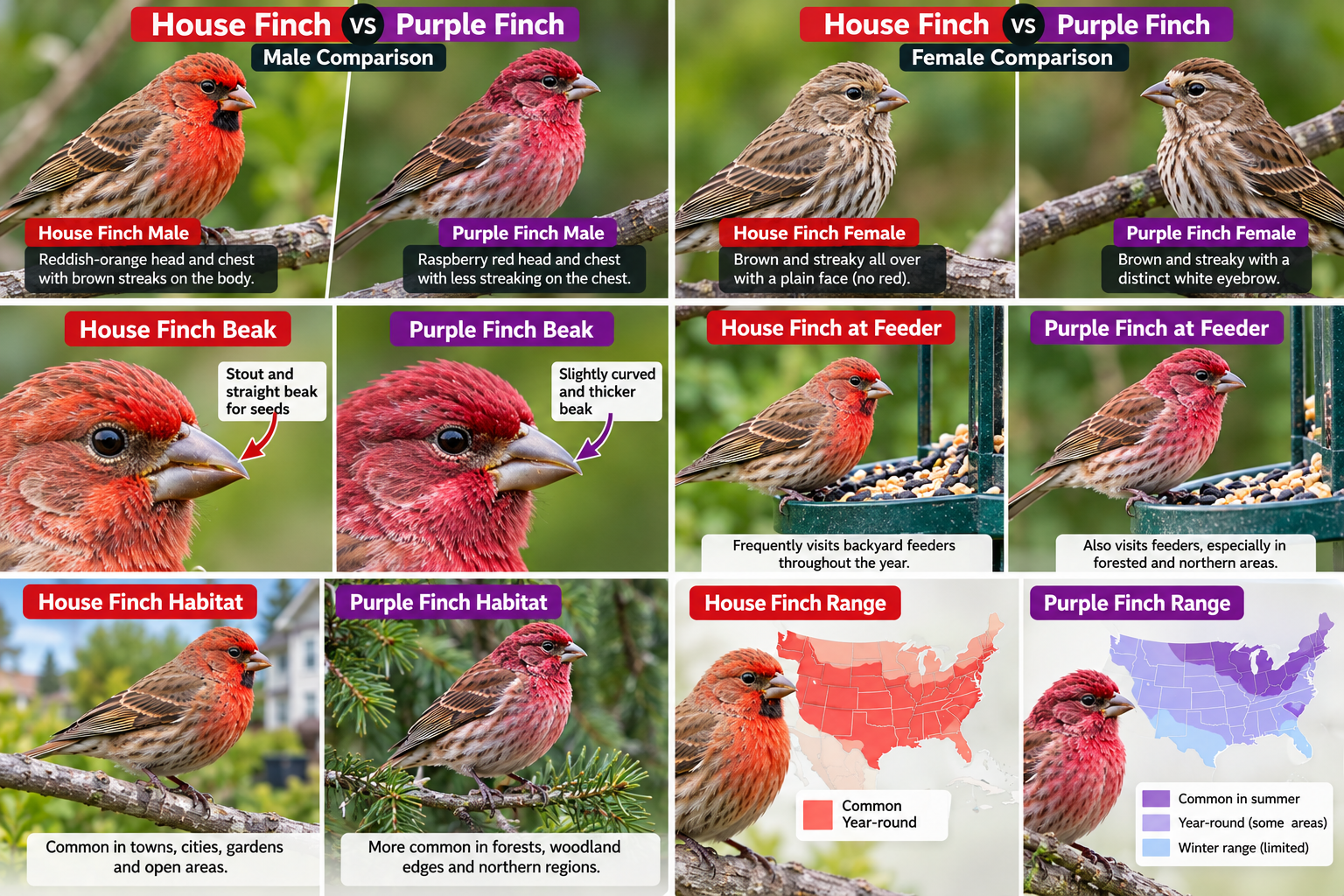
House Finch vs Purple Finch is one of the most common feeder-bird identification questions in North America. Although these two finches share a seed-cracking bill and similar body shape, their facial patterns, red coloration and streaking can reveal useful differences.
Quick answer: House Finch vs Purple Finch
The House Finch and Purple Finch are small seed-eating songbirds that can look confusingly similar, especially when a red male visits a backyard feeder. The easiest identification comes from combining several clues: head shape, the location of red coloring, streaking on the sides, and the overall shape of the bird. No single feature works perfectly in every light or plumage.
House Finch: Often has a relatively rounded head, a red or orange-red face and upper chest, and noticeable brown streaks along the lower breast and flanks. Purple Finch: A typical adult male shows a more extensive raspberry-red wash across the head, back and breast, with less obvious dark streaking below. Female and immature birds require closer attention to facial patterns and body shape.
At-a-glance identification table
| Feature | House Finch | Purple Finch |
|---|---|---|
| Male color | Variable red, orange or yellow concentrated on head, chest and rump | Often raspberry-red across head, chest and upperparts |
| Male underparts | Usually strongly brown-streaked on flanks and belly | Usually less strongly streaked in adult males |
| Head profile | Typically more rounded | Often appears larger-headed with a straighter forehead |
| Female face | Relatively plain, with limited contrasting eyebrow | Bold pale eyebrow and contrasting dark facial markings |
| Range | Common across much of the contiguous United States | More regional and seasonally variable, including northern forests and winter visitors |
These are typical field marks rather than guarantees. Age, individual variation, molt, lighting and viewing angle can change how a bird appears.
1. Compare the amount and shade of red
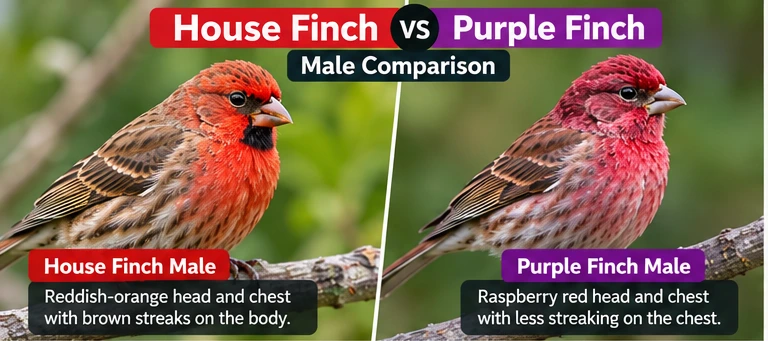
Male House Finches can be bright red, rusty orange or even yellowish because the pigments in their feathers are influenced by diet. Their color often looks concentrated on the forehead, face, throat and upper chest. Male Purple Finches usually show a more even raspberry or wine-red tone extending onto the crown, nape and back. In difficult views, color alone is unreliable, so check streaking and head shape as well.
2. Check the streaks below the breast
A male House Finch typically has a noticeably streaked white or pale belly and flanks. An adult male Purple Finch often looks cleaner or more diffusely marked below its reddish breast. A bird that is wet, fluffed up or viewed in shade can make these differences harder to judge.
3. Look at the head and bill together
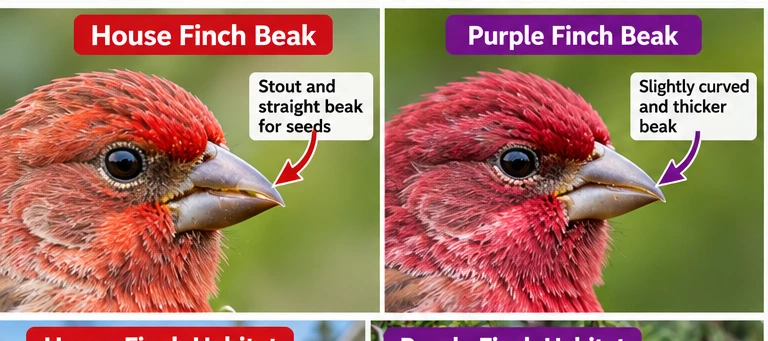
Both species have sturdy, conical bills designed for cracking seeds. A Purple Finch may appear more robust and larger-headed, while a House Finch often looks smaller-headed and rounder. The shape can be subtle, and posture matters. Avoid identifying a bird solely by bill size from one photograph.
4. Female House Finch vs female Purple Finch
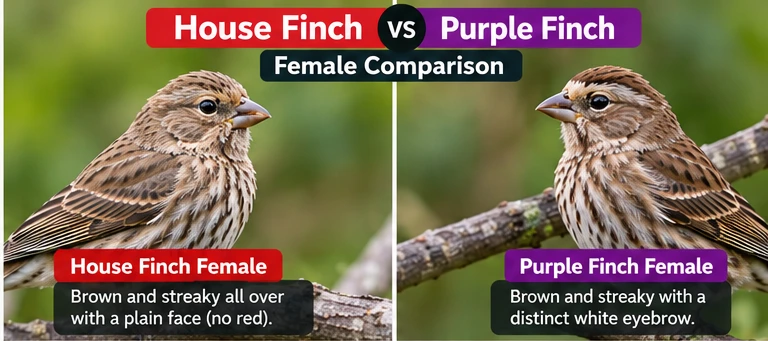
Females of both species are brown and heavily streaked, making them a common identification challenge. A female Purple Finch typically has a striking pale eyebrow, a darker cheek patch and a more contrasting facial pattern. A female House Finch usually has a plainer brown face with less sharply defined markings. Compare the face first, then examine the overall body proportions and habitat.
5. Consider the habitat
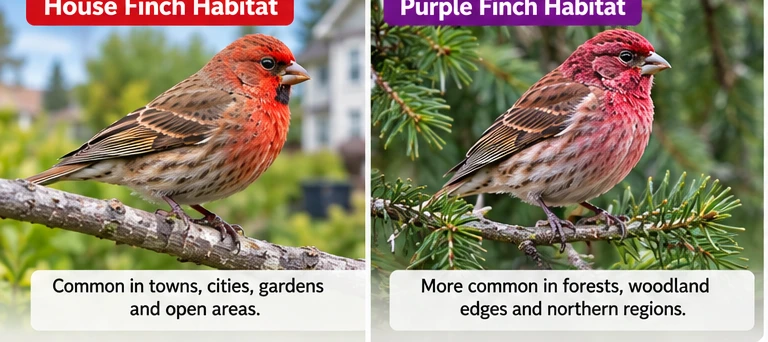
House Finches are especially familiar around neighborhoods, gardens, farms and urban feeders. Purple Finches favor wooded habitats, particularly coniferous or mixed forests, but they can also visit residential feeders. A bird at a backyard feeder is not automatically a House Finch; habitat is supporting evidence, not a final answer.
6. Use location and season
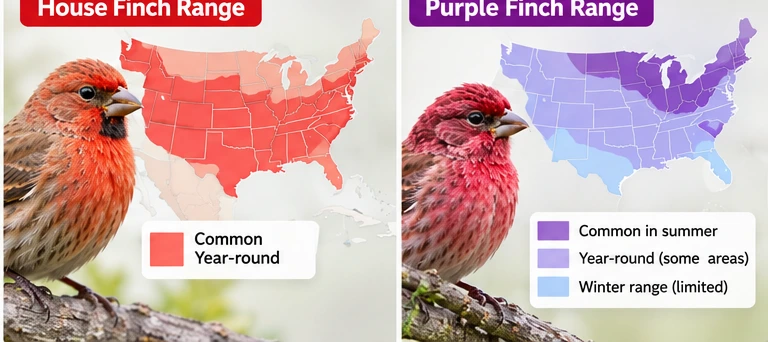
House Finches are widespread and often resident in the United States. Purple Finch distribution changes by region and season. They breed mainly in northern and northeastern forests and parts of western North America, with some populations moving south during winter. Their winter numbers can vary from year to year. Checking a current regional range map or recent local bird reports is especially helpful.
7. Watch feeding and flock behavior
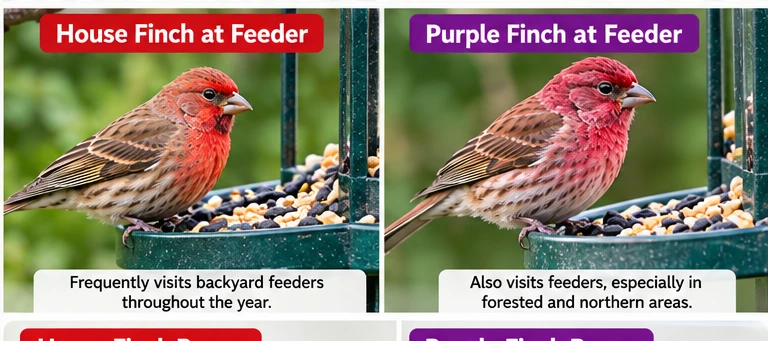
Both species eat seeds and may use tube or platform feeders. House Finches often gather in conspicuous groups near homes. Purple Finches may appear singly or in small groups, sometimes alongside other finches. Behavior offers context but overlaps too much to serve as a dependable identification mark.
8. Listen carefully to the calls
Both species make lively, musical vocalizations, and their songs can overlap in character for beginners. Purple Finch songs are often described as rich, warbling phrases; House Finch songs can be fast, varied and buzzy. Recorded examples from a reputable bird reference are more useful than trying to identify either species from a written imitation.
9. Avoid common identification mistakes
The most common mistake is treating every reddish feeder bird as a House Finch, or assuming every strongly colored red bird is a Purple Finch. Red intensity varies in House Finches. Another mistake is relying on size without a side-by-side comparison. For a more confident identification, note the eyebrow pattern, belly streaking, head shape, location and season together.
How to identify a finch from a photo
Start with a clear side-view photograph showing the entire bird. Zoom in on the face, crown, breast and flanks. Check whether a female has a bold pale eyebrow, or whether a male has dark streaking below the red breast. Note the date and location. If the image does not show these details, record the bird as an unidentified finch rather than forcing a species-level identification.
For a broader introduction to birds that visit feeders in this region, see the forthcoming Backyard Birds of the Midwest identification guide. Readers can also compare species accounts and sound recordings at Cornell Lab’s All About Birds and National Audubon Society.
For another difficult backyard identification, read our Downy Woodpecker vs Hairy Woodpecker guide.
Frequently asked questions
Is a Purple Finch actually purple?
No. The adult male usually looks raspberry-red or wine-red rather than violet or purple.
Can a House Finch be orange instead of red?
Yes. Male House Finch color varies from yellow-orange to red, partly depending on pigments obtained through food.
Which female finch has a bold eyebrow?
The female Purple Finch generally shows a more distinct pale eyebrow and stronger facial contrast than the female House Finch.
Can both species visit the same feeder?
Yes, where their ranges overlap, both can visit seed feeders. A feeder sighting alone does not establish which species is present.
1 thought on “House Finch vs Purple Finch: 9 Key Identification Differences”